DigiFLEd Webinar: Integrating Audio Tools into Interactive Language Teaching
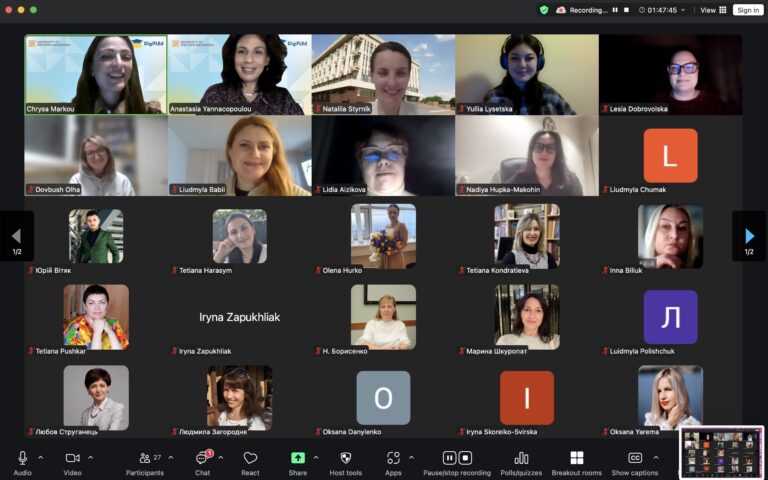
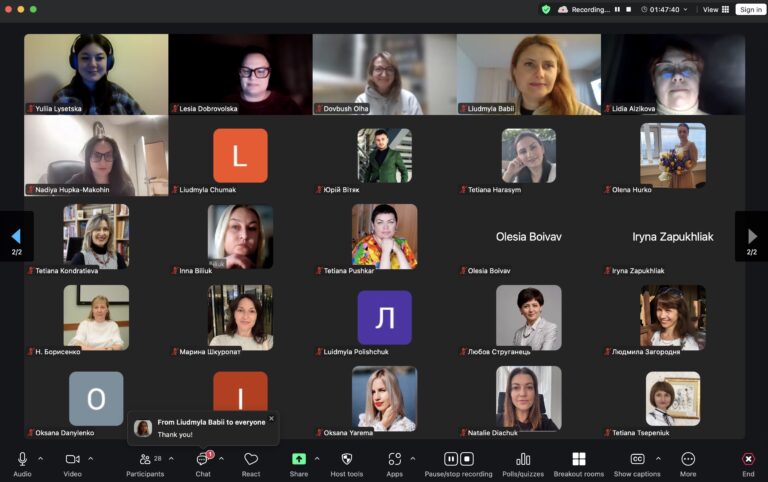
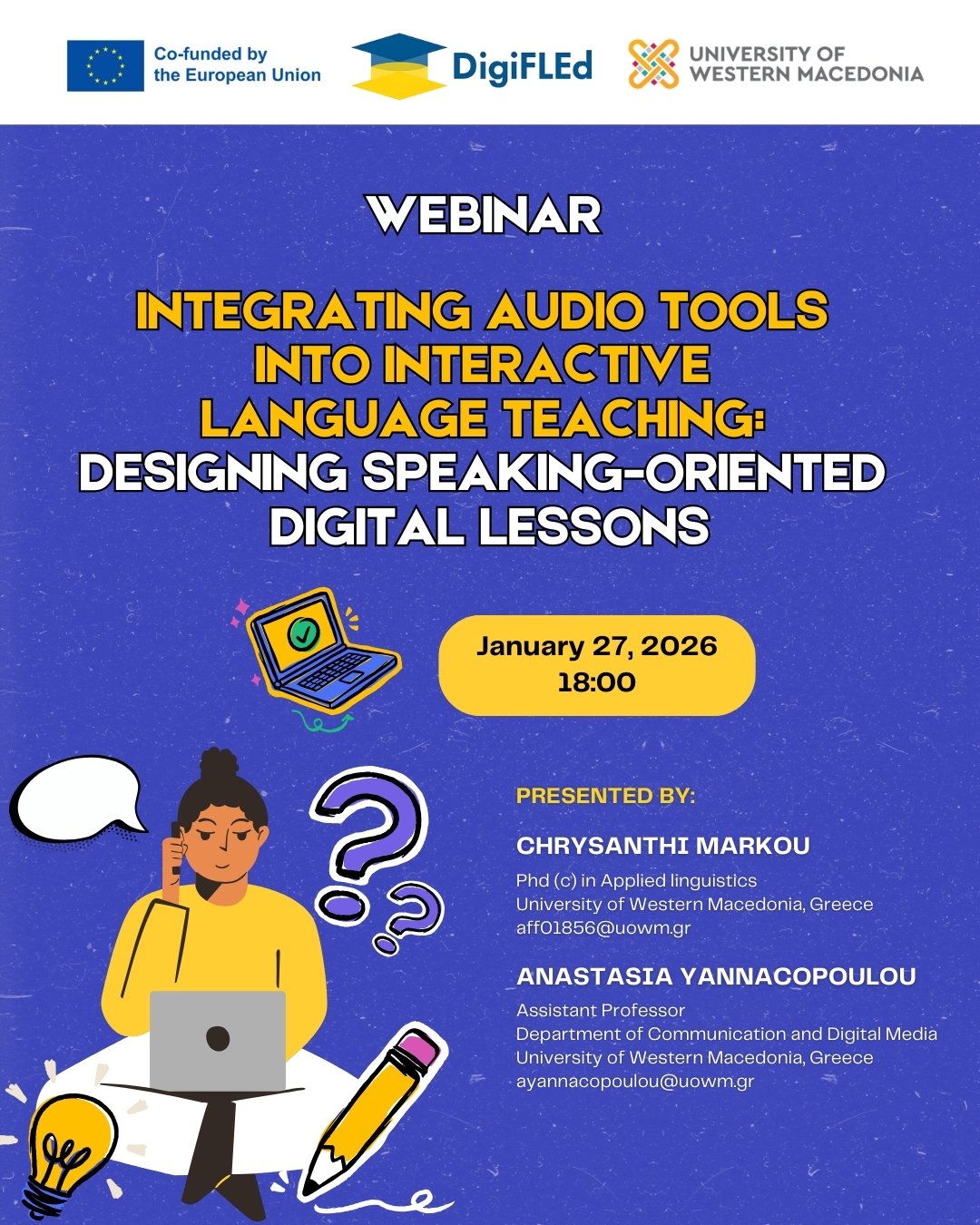
How can digital audio tools support meaningful speaking practice in language teaching within digital learning environments? This question was at the heart of the webinar “Integrating Audio Tools into Interactive Language Teaching: Designing Speaking-Oriented Digital Lessons”, which took place on 27 January 2026 as part of the Erasmus+ DigiFLEd European project.
The webinar was organised by the University of Western Macedonia and delivered by Chrysanthi Markou, PhD candidate in Applied Linguistics, and Anastasia Yannacopoulou, Assistant Professor at the Department of Communication and Digital Media, specialising in Computational Linguistics.
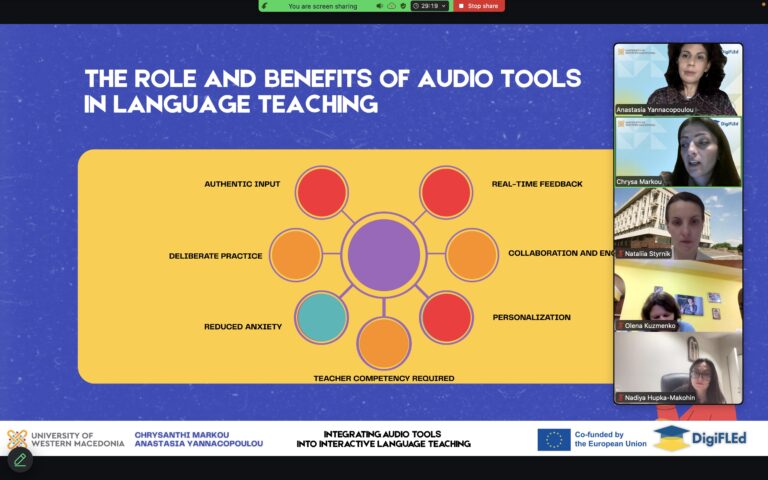
The discussion focused on the pedagogical value of audio tools and their role in enhancing speaking skills, learner engagement, and learner autonomy in digital learning environments. Emphasis was placed not merely on presenting tools, but on how these tools can be meaningfully embedded into lesson design with a clear orientation towards speaking.
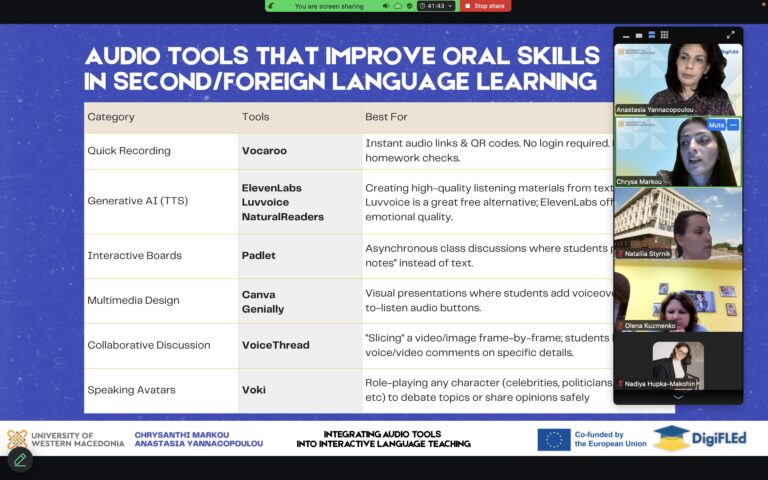
During the webinar, a wide range of digital tools was presented and discussed, including:
- Vocaroo, for quick voice recording and sharing of spoken output;
- ElevenLabs, Luvvoice, and NaturalReaders, for generating high-quality audio materials from written text using artificial intelligence;
- Padlet, for asynchronous instructions and discussions with voice comments;
- VoiceThread, for asynchronous spoken communication and collaborative interaction;
- Canva, for designing multimodal and interactive activities with embedded audio and AI-generated voice;
- Genially, for designing interactive and gamified audio-based activities;
- Voki, for role-play activities and speaking practice through avatars./
Key points of reflection included:
the role of audio tools in developing learners’ speaking fluency and confidence;
the design of interactive, speaking-oriented digital lessons;
the combination of synchronous and asynchronous audio-based activities;
challenges related to technology, student engagement, and teachers’ digital readiness;
the changing role of the teacher as a mediator and facilitator of digital learning.
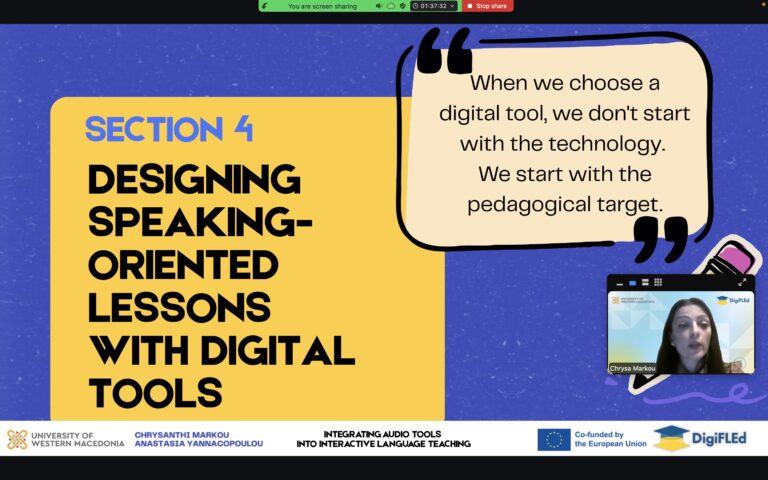
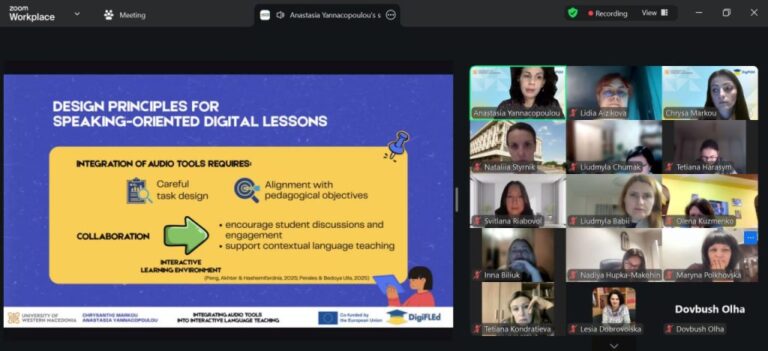
The webinar clearly demonstrated that effective development of speaking skills in digital environments depends not only on the availability of tools, but primarily on careful, pedagogically grounded instructional design. Through examples and practical strategies, participants had the opportunity to explore ways in which technology can function as meaningful support for language learning.
The event was particularly relevant for academics, teachers, and researchers in the fields of applied linguistics, language education, and digital media, offering a productive space for the exchange of ideas on current trends and practical solutions in digital pedagogy.
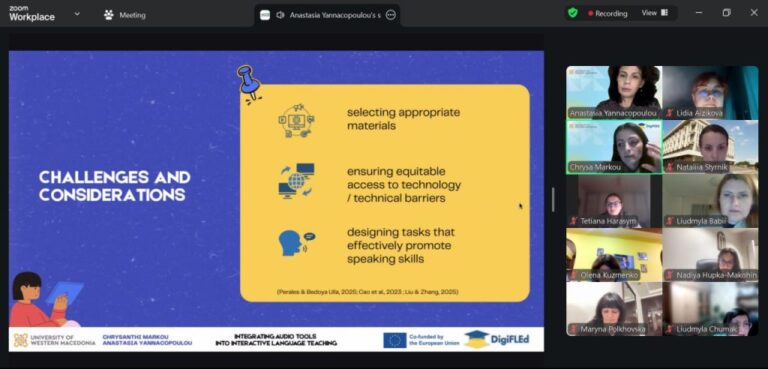
Key Takeaways from the Webinar:
1. The Role of Audio Tools in Enhancing Speaking Skills
Participants explored how tools such as voice-recording platforms, pronunciation feedback systems, and interactive audio exercises can significantly boost learners’ speaking confidence and proficiency. These tools provide opportunities for real-time practice, self-assessment, and increased learner autonomy, especially vital for such a challenging skill as speaking in a new language.
2. Designing Speaking-Oriented Digital Lessons
The speakers shared practical strategies for embedding audio tools into digital lesson design. Examples included audio-based interaction tasks, simulated conversations, and immersive listening activities that allow students to engage with native-like content. Instant feedback and repeated practice were highlighted as key elements for creating authentic, learner-centred speaking experiences.
3. Practical Strategies for Educators
The session emphasized flexibility in using both synchronous and asynchronous learning formats. Educators were encouraged to integrate audio tools into peer feedback activities, collaborative speaking tasks, and group discussions fostering a communicative environment where learners dynamically interact with both technology and one another.
4. Addressing Challenges in Digital Language Teaching
While the benefits of audio tools are clear, the webinar also acknowledged real-world challenges such as technical constraints, the need for teacher training, and maintaining learner engagement in online or hybrid contexts. The presenters stressed the importance of adaptability and balancing innovative tools with sound pedagogical practices.
5. The Changing Role of the Educator
A key insight was the evolving role of teachers in digital classrooms from content transmitters to learning facilitators. Educators are now guiding students not only in language use but also in navigating digital tools that promote speaking practice and independent learning.
Watch the Webinar:
Read more about the project: https://digifled.eu/ and https://digifled.cdm.uowm.gr/
DigiFLEd: Modernisation of University Education Programmes in Foreign Languages by Integrating Information Technologies
You may also like
Three days of academic dialogue on the future of communication at the international conference “Envisioning the Future of Communication III” in Kastoria
The first day of the international conference Envisioning the Future of Communication III (EFoC 2025) began on the morning of Monday, December 8, 2025, at the Department of Communication and Digital Media of the University of Western Macedonia in Kastoria, …
Academic calendar 2022-2023
OPEN CALL – INVITATION OF EXPRESSION OF INTEREST FOR PHD CANDIDACIES for the academic year 2022-2023
download file : OPEN CALL – INVITATION OF EXPRESSION OF INTEREST FOR PHD CANDIDACIESfor the academic year 2022-2023.pdf